 English▼



Site Blog
contact us
- If you have questions, please contact us, all questions will be answered
- Email : David@tmaxcn.com
- Email : Davidtmaxcn@gmail.com
- Add : No. 39, Xinchang Road, Xinyang, Haicang Dist., Xiamen, Fujian, China (Mainland)
hot products
Blog
Battery Coater
March 3,2026.
Xiamen Tmax Battery Equipments Limited was set up as a manufacturer in 1995, dealing with lithium battery equipments, technology, etc. We have total manufacturing facilities of around 200000 square foot and more than 230 staff. Owning a group of experie-nced engineers and staffs, we can bring you not only reliable products and technology, but also excellent services and real value you will expect and enjoy.
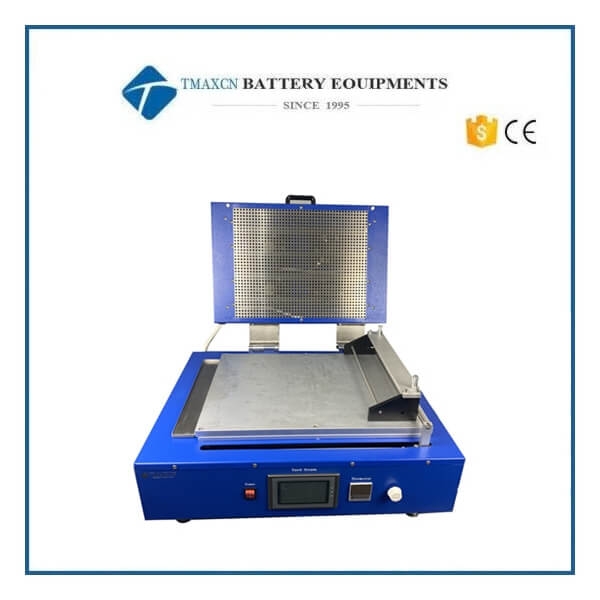
A battery coater is a specialized machine used in the production of lithiumion and other rechargeable batteries. It applies active materials (cathode or anode slurries) onto current collectors (usually aluminum foil for cathodes and copper foil for anodes) to form the electrode layers of a battery. The quality of the coating directly impacts the performance, safety, and lifespan of the battery.
In this article, we will explore the principles, types, applications, advantages, challenges, and innovations associated with battery coaters.
●Principles of Operation
1. Coating Process
The battery coater applies a uniform layer of slurry (a mixture of active materials, binders, and conductive agents) onto a metal foil substrate.
The coated foil is then dried to remove solvents, leaving behind a solid layer of active material.
2. Key Components
Slurry Delivery System: Feeds the slurry onto the substrate at a controlled rate.
Coating Head: Applies the slurry using various techniques (e.g., slot die, gravure, or blade coating).
Drying Oven: Removes solvents from the coated layer through heat or vacuum processes.
Tension Control System: Ensures consistent tension on the moving substrate during coating.
Roller System: Guides and supports the foil as it moves through the machine.
●Types of Battery Coaters
1. Slot Die Coaters
Use a narrow slot to extrude slurry onto the substrate.
Provide precise control over thickness and uniformity.
Widely used in modern battery manufacturing.
2. Gravure Coaters
Employ engraved rollers to transfer slurry onto the substrate.
Suitable for highspeed production but less common in battery manufacturing due to complexity.
3. Blade Coaters
Use a blade to spread slurry across the substrate.
Simple and costeffective but may result in less uniform coatings compared to slot die coaters.
4. Doctor Blade Coaters
Similar to blade coaters but use adjustable blades for better thickness control.
5. Rotogravure Coaters
Combine gravure and rolltoroll technology for highspeed, highprecision coating.
●Advantages of Battery Coaters
1. Uniform Coating
Ensures consistent electrode thickness, which improves battery performance and safety.
2. High Throughput
Capable of processing large quantities of material efficiently, supporting mass production.
3. Precision
Advanced coaters offer submicronlevel control over coating thickness and weight.
4. Versatility
Can handle a variety of slurry formulations and substrate materials.
5. Automation
Many coaters are equipped with automated systems for realtime monitoring and adjustment.
●Challenges in Battery Coating
1. Thickness Variability
Even small deviations in coating thickness can affect battery performance and lifespan.
2. Solvent Evaporation
Inconsistent drying can lead to defects such as cracking or uneven density.
3. Particle Agglomeration
Poor mixing or settling of slurry particles can result in nonuniform coatings.
4. Edge Effects
Coating near the edges of the substrate can be challenging, leading to waste or defects.
5. Cost
Highperformance coaters can be expensive to purchase and maintain.
Battery coaters are essential in the production of various types of batteries:
1. LithiumIon Batteries
Used in electric vehicles (EVs), consumer electronics, and energy storage systems.
2. SolidState Batteries
Emerging technology requiring advanced coaters for thinfilm deposition.
3. NickelMetal Hydride (NiMH) Batteries
Common in hybrid vehicles and portable devices.
4. SodiumIon Batteries
Alternative to lithiumion batteries for gridscale energy storage.
5. Research and Development
Smallscale coaters are used in labs to test new materials and formulations.
●Innovations in Battery Coater Technology
To address challenges and enhance performance, manufacturers are developing advanced battery coater solutions:
1. Smart Monitoring Systems
Incorporate sensors and AI for realtime quality control and defect detection.
2. UltraThin Coating
Developments in precision coating enable thinner electrodes for higher energy density.
3. Dry Coating
Eliminates the need for solvents, reducing environmental impact and costs.
4. RolltoRoll Processing
Continuous coating systems for faster and more efficient production.
5. Customizable Configurations
Tailored designs for specific materials, thicknesses, and applications.
●The Future of Battery Coaters
As battery technology evolves, so too will the tools used to manufacture them. Key trends shaping the future include:
1. Increased Precision
Development of nanoscale coating capabilities for nextgeneration batteries.
2. Focus on Sustainability
Ecofriendly designs and processes to minimize waste and reduce environmental impact.
3. Integration with Emerging Technologies
Combining coaters with AI, IoT, and robotics for smarter and more efficient production.
4. Global Standards Compliance
Ensuring compatibility with evolving international regulations for battery manufacturing.
5. Expansion into New Markets
Adapting coaters for emerging fields like aerospace, marine, and quantum computing.
●Conclusion
Battery coaters are a critical component of modern battery manufacturing, enabling the production of highquality electrodes that power our daily lives. Their continuous evolution is crucial for meeting the growing demands of industries ranging from EVs to renewable energy storage.
What excites you most about the advancements in battery coater technology? Share your thoughts below! Together, let’s explore how these innovative tools can shape the future of battery manufacturing and energy storage.
 +86 13174506016
 David@tmaxcn.com

