LABORATORY PRESS
TMAXCN® Since 1995
LABORATORY PRESS
Empowering Innovation in Materials Science

Pellet Press
Manual/Electric/Automatic Selection
2T-300T Option
Split Design Optional for Large Tonnage
Various Molds. Sizes Customized Per Request
Fluorescent-specific Press Available for Selection
| Classification |
Manual |
Manual/Electric |
Automatic |
| Features |
Pressure: 2~60Tons
Control: Fully manual (Hydraulic handle)
Display: Mechanical dial (approximate)
Data function: None
Automation: Low (Manual press & hold)
Safety: Basic (Physical limit)
Advantages: Simple structure,durable, cost-effective
|
Pressure: 12~300Tons
Control: Electric auto (Touch screen+ 1‑Button)
Display: Digital(Tons/MPa)
Data function: Basic (Parameter setting, program storage)
Automation: Medium (Auto press, hold & release)
Safety: Medium (Max pressure limit)
Advantages: Easy operation, hands‑free, good repeatability
|
Pressure: 12~300Tons
Control: Smart touch screen(7"+Program Control)
Display: High‑precision digital (0.01 T)
Data function: Advanced(Curve graph,USB/Excel export, PC link)
Automation: High (18‑step programming, auto press & hold)
Safety: High(Auto release,limit switch, protective door)
Advantages: Data traceability,high pressure,research‑grade accuracy |
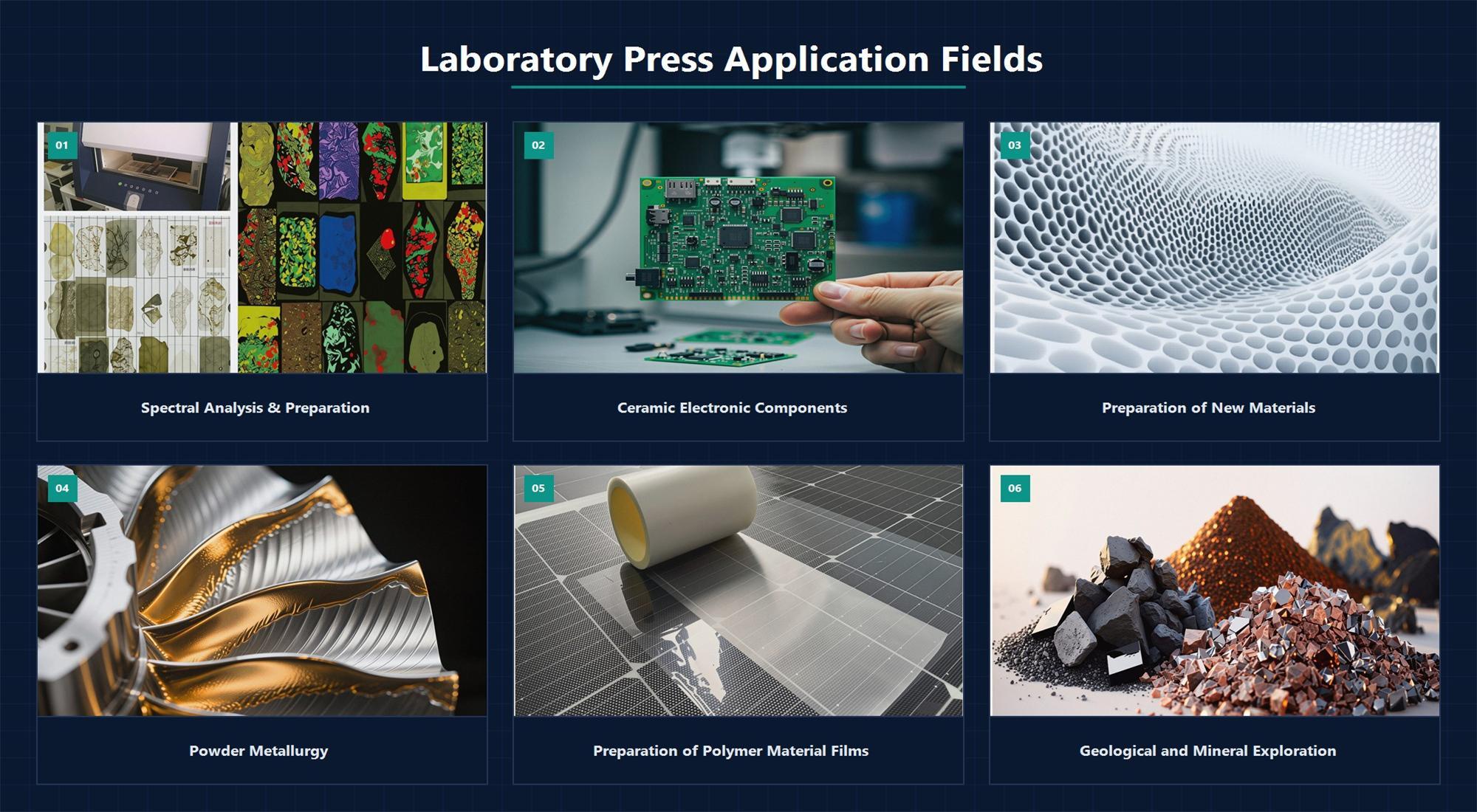
1. Spectral analysis sample preparation
2. Battery material research
3. Ceramic electronic components
4. Geological and mineral detection
|
| Picture |
 |
 |
 |
 |
 |
| Note |
Optional separate‑style automatic model |
Optional fluorescent pressing machine |

Isostatic Press
Manual/Electric/Automatic Selection
12T-300T Options
Maximum Working Chamber φ110×150mm
Oil Pressure MediumHip Press Available for Selection
| Classification |
Manual |
Manual/Electric |
Automatic |
| Features |
Specs: 12~60T;
0~300/500MPa;
Chamber: Φ22x70~Φ50x150mm (300MPa); dual‑scale gauge
Control: Manual pressurization
Safety: Glass protective cover
Note: Recommended system pressure≤35MPa
|
Specs: 12~60T; 0‑300/500MPa
Chamber: Φ22x70~ Φ50x150mm (300MPa); 0.1T accuracy
Control: Electric/Mechanical (Auto‑replenish/Manual step‑by‑step)
Safety: Glass protective cover
Features: Integral non‑sealed structure
|
Specs: 20~300T; 0‑300/500MPa
Chamber: Φ30x150~ Φ110x150mm (300MPa); 0.1T accuracy
Control: 18‑step program(Adjustable speed)
Safety: Steel+Plexiglass door; Auto overpressure protection
Features: Curve display, USB export, Remote PC control
|
1. New material preparation
2. Battery research
3. Powder metallurgy
4. Food and medicine
5. Research testing
|
| Picture |
 |
 |
 |
|
 |
| Note |
Optional one‑piece automatic model |
Optional hot isostatic press machine |

Hot Press
Manual/Automatic Selection
5T-60T Options
Heating Temperature Range: RT-300℃/500℃/800℃
Program Control: Up to 18 Segments (Temp/Pressure/Cooling Independent)
Cooling System: Water-Cooled Rapid Cooling (Auto/Manual)
Vacuum Hot Press Machine Available for Selection
| Classification |
Manual |
Automatic |
| Features |
Specs: 5‑60T; 0.01 accuracy;
300/500/800℃ options; 100x100~500x500mm plate
Control: 18‑Step program (Temp/Pressure/Cooling independent)
Cooling: Water‑cooled (Manual/Auto rapid cooling)
|
Specs: 5‑60T;0.01T accuracy;
300/500/800°C options; 100x100~500x500mm plate
Control: 18‑Step program (Temp/Pressure/Cooling independent)
Cooling: Water‑cooled (Manual/Auto rapid cooling)
Safety: Acrylic protective door + Emergency stop button
|
1. Preparation of polymer material films
2. Laminated curing of composite materials
3. Hot pressing of special ceramics and metal powders
4. Thermal pressing in glove box atmosphere protection
5. Electronic packaging and functional materials
|
| Picture |
 |
 |
 |
| Note |
Optional integrated manual model |

Press Mold
Optional Circular Sample, Rectangular Strip, Ultra-Thin Film/Special Shape
Optional Cold Pressing Mold/ Hot Pressing Mold
Optional Cr12MoV/Japanese ASSAB+17/YT15 Material
Micro Sample/Conventional Laboratory Size/Large-Size Molding
Manual Demolding/Spring-Assisted Demolding/Split Structure
How to select the Right Model?
Q1: I just conduct regular XRF spectral analysis or press simple metal pills. Which one should I choose?
Choose the ordinary press machine. It has low cost and the highest efficiency.
Q2: I want to press ceramic powder or wood powder. When pressed at room temperature, it always separates and cracks. What should I do?
Choose the cold isostatic press machine. The liquid presses in all directions, completely solving the problem of layering.
Q3: I want to solidify plastic films or carbon fiber plates, or the powder cannot be pressed firmly at room temperature?
Choose the hot press machine. Heating softens the material or causes cross-linking reactions, making easy molding.
Q4: The budget is limited, but I need the sample to have uniform density (isostatic pressing effect). How should I choose?
Choose the movable cold isostatic press machine. I exchange the equipment cost for sample quality, and the sample quality is not compromised.
Q5: I'm doing high-end research and need to record the complete pressure/temperature curve and export it to Excel?
Choose the intelligent programmable hot press machine or the fully automatic isostatic press machine. It supports data traceability and meets the requirements of the research level.
| Upper molds |
 |
 |
 |
| Circular |
Square |
Splicing |
 |
 |
 |
| Annular |
Hexagonal |
Heightened |
 |
 |
 |
| Multi‑hole |
Bidirectional Pressurization |
Circular Heating |
| Lower Molds |
 |
 |
 |
| Circular Heating |
Flat Heating |
Hot Press Square |
 |
 |
 |
| Hot Press Shaping |
Hot Press Shaping |
Water‑cooled Cooling Plate |
| Note: Different shapes and sizes can be customized as needed. |


 English▼





 +86 13174506016
 David@tmaxcn.com


